
M17 General Strike for a own minimum wage: + sovereignty + social cohesion
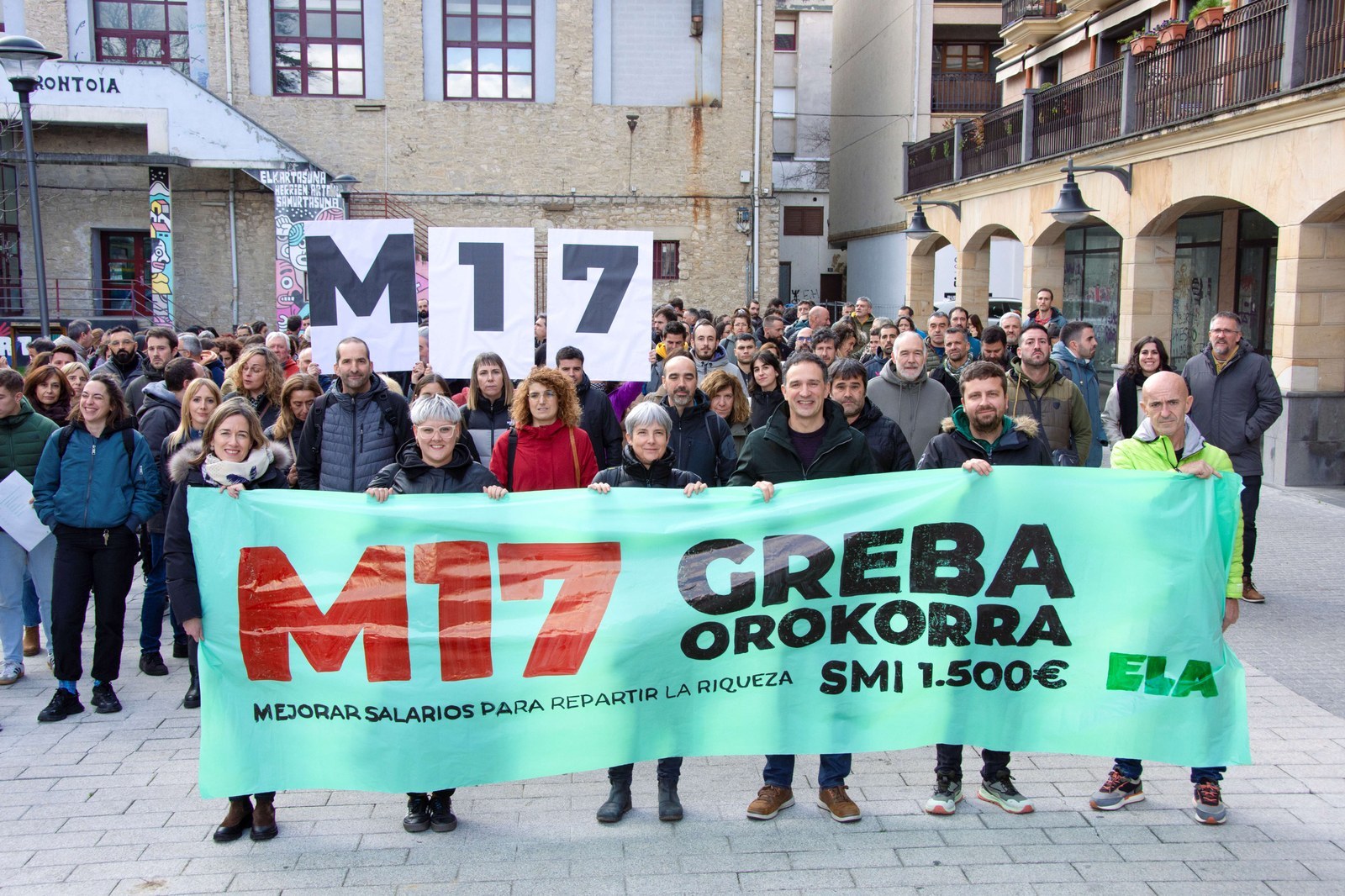
While the Parliament of Navarre used legal reports as a pretext to refuse the debate, in the Basque Parliament, the votes of the PNV, PSE, PP, and Vox parties blocked it, disregarding more than 138,000 signatures in support of the Popular Legislative Initiative (ILP1). It should also be noted that the unions have filed a complaint against the Basque employers in the High Court of Justice of the Basque Country (TSJPV), because they refuse to negotiate an own IMW for the CAPV. The ILP defended by the Pensioners' Movement to guarantee a minimum pension equivalent to the SMI (Minimum Interprofessional Wage) was also rejected by the institutions, and has not even been debated.
Therefore, ELA, along with the other unions, has agreed to give a strong response to the Basque Government and the Government of Navarre, as well as to employers' associations, by calling a general strike for March 17. “It is very serious that political representatives are denying society the only way to propose legal changes; they are severely limiting democracy.” Furthermore, the calling unions emphasize that “an exercise of self-government and sovereignty that seeks to defend the rights of the working class has also been disregarded; both the Basque Government and the Government of Navarre, as well as employers' associations, want to impose Spanish labor legislation to further precarize the Basque working class.”
In this regard, the unions calling the strike are initially proposing a minimum wage of €1,500 (the Spanish minimum wage is €1,184), which should be set by the Basque Parliament and the Parliament of Navarre after the necessary amendment to Article 27 of the Workers' Statute in the Spanish Congress of Deputies to empower the autonomous communities to create their own minimum wages. Therefore, Basque political parties are urged to bring this demand to Madrid and negotiate its approval. Similarly, the demand remains for employers' associations to sign inter-professional agreements setting their respective minimum wages at €1,500 per month.
If this demand, the central focus of the general strike on March 17, were to materialize, the minimum wage would become the basis of a social protection system that is currently very insufficient. Achieving a minimum wage of at least €1,500 will have a direct impact on the most vulnerable groups (young people, migrants, women, and people with disabilities), and at the same time, it will demonstrate solidarity from broad sectors of society. This €1,500 should also become the minimum pension, fulfilling one of the main demands of the Basque Country Pensioners' Movement. As is well known, an increase in the minimum wage would influence collective bargaining, contributing to higher wages in other sectors, making this general strike an essential event for the entire working class.
The central demand of this strike involves an exercise in social sovereignty: a better distribution of wealth and greater social cohesion through new powers for Hego Euskal Herria.
1The ILP is a mechanism of direct democracy that allows thea citizenship to propose the creation or modification of laws directly to the legislature.