
40 years since the NATO referendum: trade unionism as a counter-power to the new imperialism
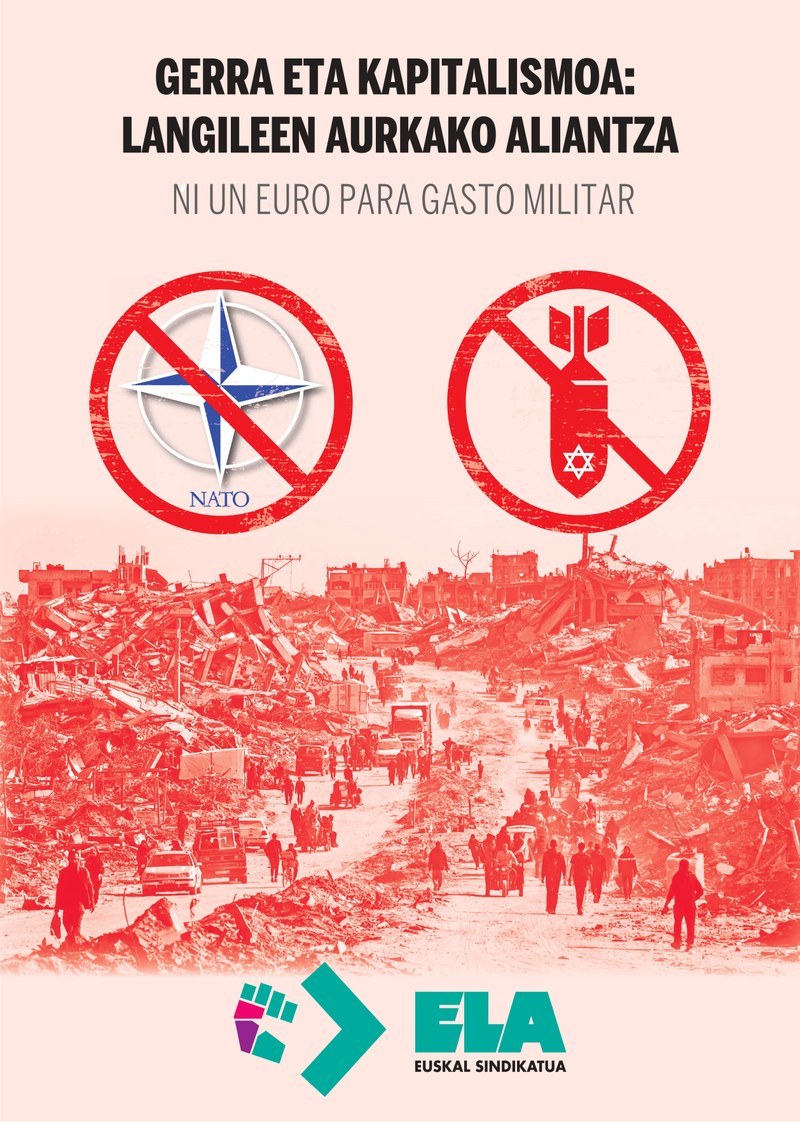
It is 40 years since the referendum on the membership of Spain in NATO, held on 12th March 1986. That day marked a significant political moment in Europe and in the Spanish State. Although the overall result was favourable to the permanence in the military alliance, in some territories —among them Euskal Herria— the social majority clearly positioned itself against.
The ELA members remember that episode not only as a historical fact, but as a fully valid political reference. Four decades later, the international context is marked by a new cycle of confrontation between powers, the increase in military spending and a growing militarisation of European politics. In this context, it is essential to open an in-depth debate on Europe's direction and the need to reorient its policies towards peace, social justice and cooperation between peoples.
In recent years, the European Union has reinforced an agenda combining neoliberal economic policies with a growing strategic subordination to NATO. The increase in defence spending, the centrality of the arms industry and the subordination of political decisions to geopolitical interests are forming a model that is increasingly remote from the social needs of the citizens. In view of this, European priorities must be redirected towards strengthening social rights, redistributing wealth, a fair ecological transition and the effective defence of democracy.
In this debate, it is also inevitable to question the role of NATO in the current international order. The Atlantic Alliance was a pillar of the military architecture that emerged after the Second World War and during the Cold War. However, far from disappearing after the end of that historic period, NATO has expanded its scope of action and its political influence. From the perspective of peace, international cooperation and the sovereignty of peoples, we advocate a security system based on demilitarisation and international law, which also means opening the debate on dissolving NATO.
The construction of an alternative requires that the sovereignty of peoples and the democratic control of strategic resources be placed at the centre. Energy, food, health, care, finance, industry or technology cannot be subordinated to corporate interests or to military logic. They must be managed collectively to ensure social rights, wealth redistribution and gender equality. These demands are part of a political and trade union strategy aimed at building an anti-fascist and profoundly democratic society.
Our trade union tradition has always been linked to internationalism. ELA was in 1973 one of the unions that founded the European Trade Union Confederation (ETUC) and has since been an active part of the European trade union movement. This commitment expresses our conviction that solidarity between workers must go beyond borders. At the same time, we have maintained a critical position with the evolution of the European Union when its policies have reinforced the neoliberal orientation, weakened labour rights and put the interests of capital before those of peoples and the working class.
ELA understand that the fight against militarism is closely linked to the social struggle. The advancement of the extreme right, the deterioration of labour rights and the increase in inequality are all part of the same process. Therefore, strengthening trade union power, class awareness, anti-racism, feminism and the defence of the Basque language are central elements of our daily work.
Forty years after that referendum, we continue to argue that another kind of society is possible: one based on peace, real democracy and the sovereignty of peoples. At a time when Europe is debating its future, trade unionism must also assume its historic responsibility and act as a real social and political counter-power, capable of organising the working class and of promoting an eco-socialist and feminist transition that gives priority to life and the rights of the social majority.